Nostalgia and painful memories
15 November 2022
In the 1990s, many Iraqis fled their country. Some of them ended up in the Netherlands. As the years pass, some Iraqi Dutch struggle with the question of whether they can and want to return to Iraq, or whether their future lies permanently in the Netherlands. Entisar El Ghareeb, an Iraqi himself, spoke to two compatriots about their struggles.
Many stories that Iraqi Dutch tell each other are nostalgic and accompanied by painful memories of the flight and expulsion from Iraq, and the loss of family members and close friends. Life in exile is dominated by the longing for a reunion with Iraq, but also by building a new existence in the foreign country and rediscovering one's own Iraqi identity.
No more hope
Ali M. (58) has been in the Netherlands for more than 20 years. He is from Baghdad and was trained as an economist. In his family, almost everyone holds an academic title. His voice is soft, his tone seems hopeless. He sounds as if he is carrying a secret, as if he is afraid of something still in the future. It keeps him from going back to Iraq. He speaks Dutch with some difficulty. Ali is sad about everything he has been through.
‘In Baghdad, I worked as a shopkeeper in Alsaray market, in the city centre. When I came to the Netherlands in late 1999, I was still young. The years passed by like a bolt of lightning. I come from a well-off family, but here in the Netherlands I still haven't found a job. I don't want to go back to Iraq. The destruction I used to see still touches me. I remember the many militias, the military uniforms. There was danger everywhere. The streets close to us in our neighbourhood were frighteningly empty and quiet.
There was a great fear in people's hearts. Freedoms were curtailed. Even today, there is still a lack of security. Despite the downfall of the former regime, many still feel unsafe. I left my family and friends and came to the Netherlands, alone. Earlier, I lost friends during the First Iraq-Iran War and in the Second Gulf War. I have no hope left and no future to hold myself to.’
‘I wanted to save my family’
Joeli K. is a Kurdish woman in her mid-forties. I meet her at a language centre in Almere. She would like to tell dozens of stories. Many times she describes the horrors, events, conflicts, wars and experiences of her past. In the course of our conversation, tears flow from her big eyes.
‘In 1996, fearing bombings, I felt forced to leave my native village of Dohouk in northern Iraq with my parents. On one side were Kurdish parties, on the other the Iraqi regime. Moreover, Iraq was subjected to an economic blockade during the same period.
I was a young woman with small children. I wanted to save my family from death. On the way, we trekked for three days through a rugged mountainous area, trapped by snow and rain, without food and water. My husband later found us sleeping on a cattle farm. I came to the Netherlands to escape the horrors of this war.
Return to Iraq
In 2006, I returned to Dohouk with my husband. We thought life would have become easier there, But the wind had driven the ships off course; we were shocked by the bitter reality. We made many attempts to survive and build a new life, but we did not succeed. I worked there as a taxi driver, to get money and provide a decent living for my children.
There was a lot of chaos, administrative corruption, missed opportunities. Lots of high-rise glass and steel buildings, shops with foreign brand names, modern cars. A new, rich class emerged, at the expense of the poorer population. In 2019, I decided to return to the Netherlands. My husband did not want to come with me, causing our family to break up. I was afraid my children would forget the Dutch language. I wanted to offer them a better future. Many Kurds still consider emigrating. But conditions in Iraqi Kurdistan are at least as bad as in other parts of Iraq.’
For security and privacy reasons, the interviewees were given fictitious names.
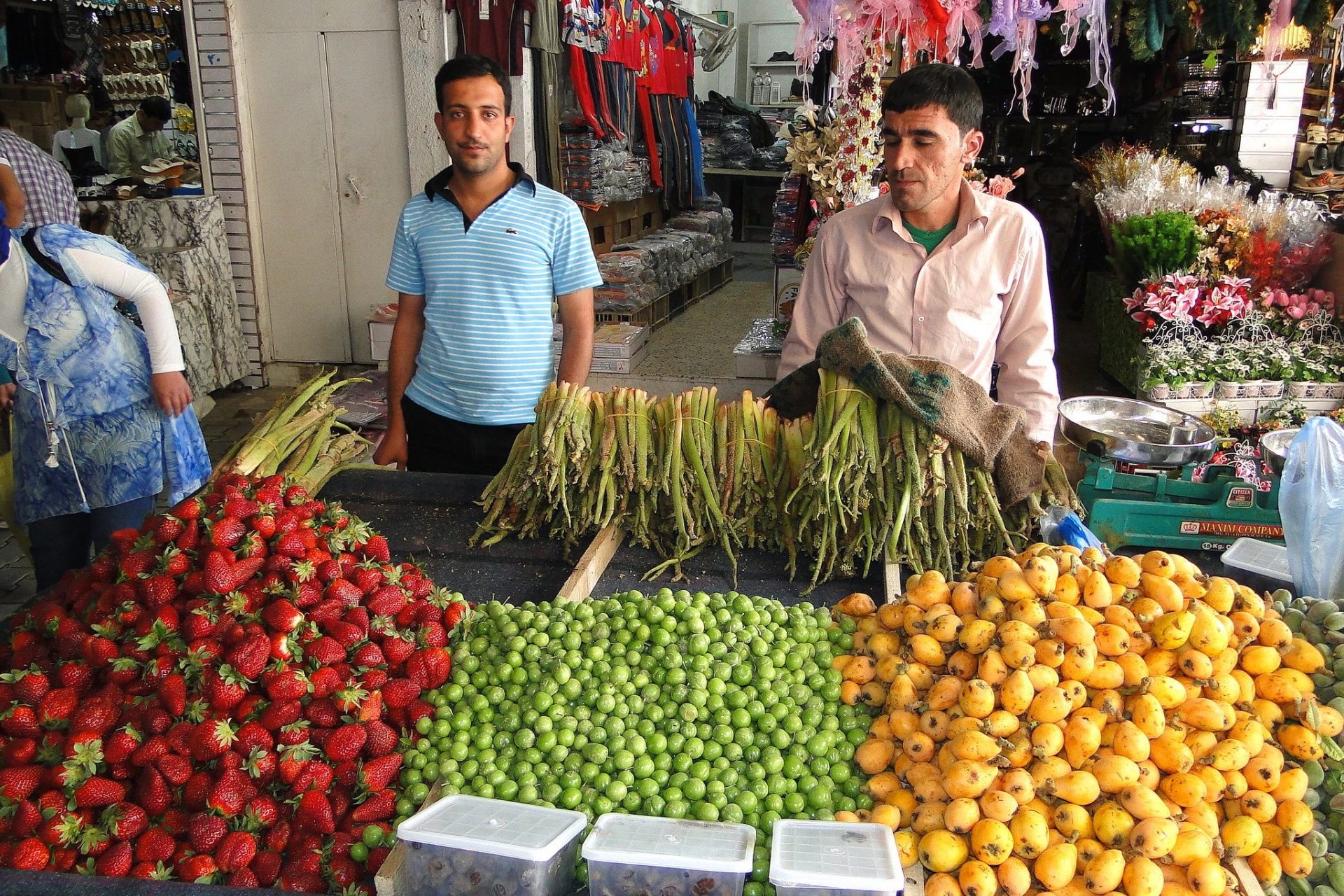
Photo above this article: Market stall at bazaar in Erbil, Iraqi Kurdistan (2011). Credit: Adam Jones (via Flickr, CC BY 2.0)

Rate this article
You read this article for free. Do you think the article and our efforts are worthwhile? Then you can show your appreciation by making a contribution. This way, you help our journalists and RFG Media.
Read more
 If we don’t tell our stories now, who will – and when?
 From Amsterdam to Macondo. On the true magic of Colombia
 ‘The migration debate isn’t about migration at all’