‘Literature is the anchor of my life’
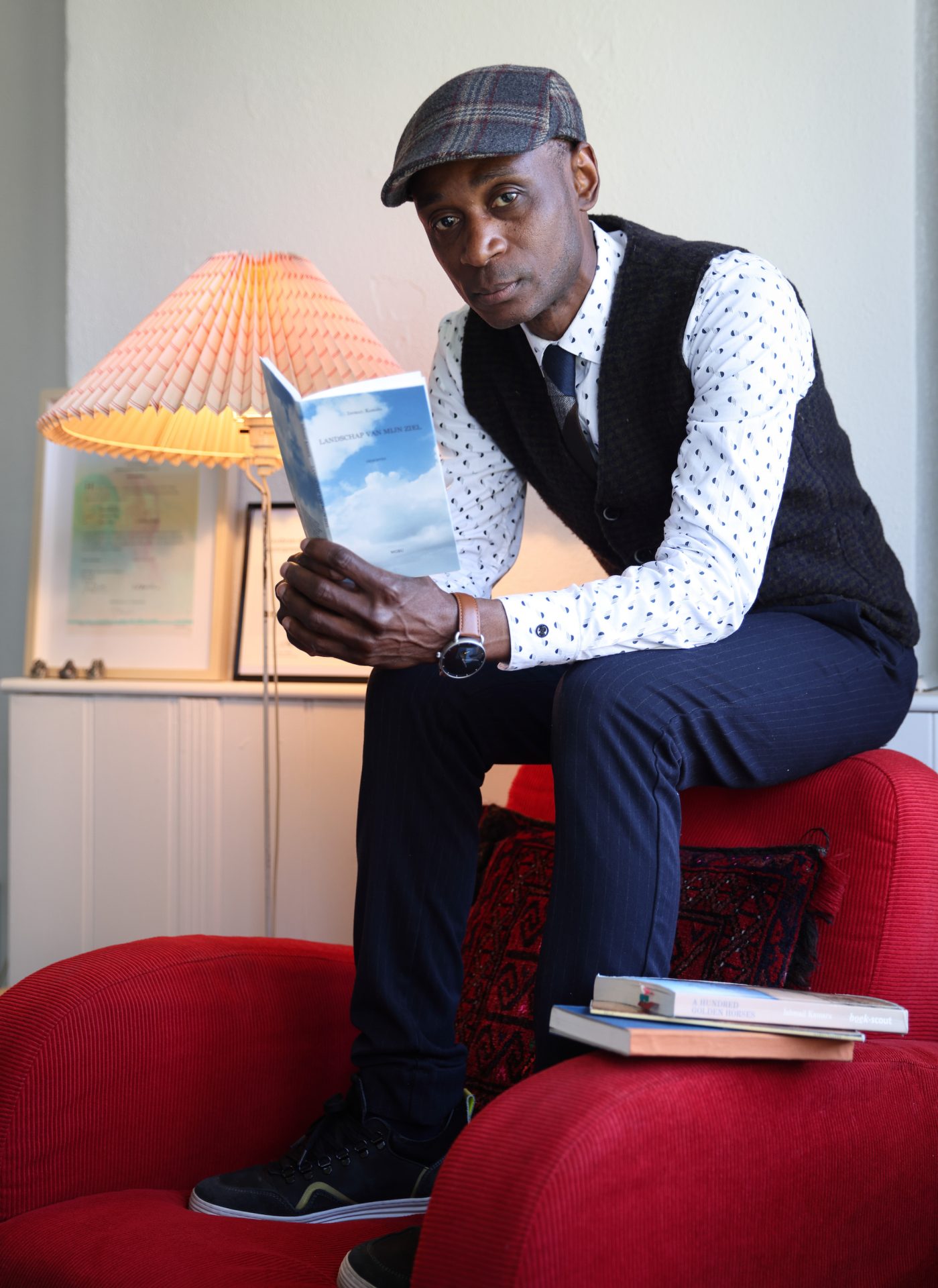
For 25 years, ONfile Foundation was a home for refugee media makers. Earlier this year, the foundation was dissolved. We spoke to six people who were involved with ONfile over the years, as directors, collaborators or members. The interviews were published in the booklet ‘It felt like coming home’ - A look back at 25 years of ONfile. In the coming time, we will also publish the interviews at RFG. In this first episode: Ishmail Kamara
“I am a poet and writer from Sierra Leone. I now live in Rotterdam, but was born in Rotain Bana, a small village of about five hundred people. My native village is sandwiched between the swamplands of Kambia district and the border with neighbouring Guinea. I came to the Netherlands in 2012, I was 22 years old at the time. I had to flee the beautiful country where I was born and leave everything behind. I had to wait 10 years for a residence permit. For years I lived as someone without papers, but I always remained positive. For me, laughter is a way of walking through fire. Even as a child, I was like that. My laughter made me calmer and stronger; I saw it as a strength. But behind a smile is often pain.”
No place like home
“I have now integrated well into Dutch society and made new friends here, but I still regularly think back to Sierra Leone, to my village and to my family members and friends. ‘There is no place like home’, as the saying goes. In my case, it does not mean that I am unhappy in my adopted new country, it does mean that I miss some aspects of my culture, such as the language and the food.
The North Sea coast, with its beautiful beaches and blue skies, sometimes reminds me of home. The big difference are the weather and the seasons. Sierra Leone and most of West Africa have no winter. Although I am fascinated by the beauty of the Dutch landscape and people, I am devastated by winter. For the first three years I lived in the Netherlands, winters made me depressed. Until someone told me to take vitamin D supplements to boost my immune system, that helped. The arrival of summer makes me happy every time and dispels my winter blues.”
Stories from grandma
“In Sierra Leone, I had to drop out of secondary school to take over my father's farm work. That's how I became a farmer, growing rice. Here in the Netherlands, I had to rediscover myself. Ten years ago, I started writing, something I never did in my home country. I grew up in a culture where stories are told, not written. My grandmother, who raised me, was a very good storyteller. I loved listening to her stories. In that way, literature lived in my family, history was passed on in the form of stories. And although a career as a writer is not an obvious choice for a school leaver from Sierra Leone, I was always interested in writing. At school, I was good at English. People asked me to read letters to them, or to write them for them. I didn't read much then because there were few books in my area. But if I found a book, whether it was a Bible or a Quran, I tried to read it.”
Writing as therapy
“My writing began by chance. During a workshop, we had to tell stories on a stage. A Dutch artist told me he saw a writer in me. At first I was shocked: ‘How can someone like me be a writer?’, I shouted. In my culture, someone who writes a book is highly educated, not someone like me. The artist gave me an assignment, he asked me to write a text and have it read to him the following week. I went home and had no idea what to put on paper. As I sat on my bed, I looked at the mirror on my wardrobe and saw myself smiling. That moment inspired the opening of my first poem ‘Smile’: ‘When I look in the mirror on my wardrobe, I see a man just like me - I smile at him and he begins to smile at me.’
After I wrote my first poem, I felt a need to continue writing. It became a form of therapy for me. Whether indirectly, through metaphors, or directly, writing poems and stories helped me clear my head and stay strong. It also gave me a purpose and a sense of self-respect. These were things I needed in the situation I was in, as someone without residence papers. Writing helped me discover that I needed to put down the heavy backpack I was carrying.
Almost all subjects lend themselves to my poetry. Sometimes I write as an activist, other times I choose a universal human perspective. In the end, it is always about humanity, that which makes us human. For me, that is the soul. A man without a soul is a lost man.”
A different person
“From the moment I started writing, I have been reciting my work in front of an audience. The stage has always been important to me. I started writing in English. Many Dutch people understand that language, but don't feel it. When I recite my poems from the stage, they do feel it. Even if I recite poems in Timne, a language hardly anyone in the Netherlands understands. On stage, I become a different person. It seems as if someone else is speaking from within me. People appreciate my power of speech. I may not write the best poetry, but it is my recitation, my presence, that makes me a poet. My publisher said: ‘I have published people who write poetry, but you are a poet.’
My writing includes poems and novels; I already have three publications to my name. My debut, ‘Smile’, a collection of English-language poems, was published in 2018. In 2020, my first novel was published, ‘A Hundred Golden Horses - A Journey to the Promised Land’. The novel is about a young man travelling and deals with themes such as human smuggling and other dangers travellers face along the way. It is not an autobiography. I have used my own experiences, but it is equally about the experiences of thousands of other people.
Although English is not my mother tongue, it is the official language in my country because of its colonial past. My mother tongue, Timne, has no written form. Therefore, I write primarily in English, although I have also started writing more and more in Dutch. My first Dutch-language poetry collection, ‘Landschap van mijn ziel’, was released in 2021.”
Network
“From the beginning, I used my work to tell about the lives of undocumented people. That's why I also participated in the documentary series Leven in Limbo, about undocumented people in Rotterdam. I wanted to show how I survived on the streets. Many Dutch people cannot imagine how you can live in such a situation. I show how I always tried to stay positive; I did not want to think about the things I could not or should not do, but focused on the things that were possible. Like my artistry, which is mine and no one can take it away from me.
My gigs as a poet also helped me build a network. After each event, I met new people; a snowball effect developed. Through these contacts, I also started giving poetry workshops at companies and schools. Occasionally, I act as a presenter. I have also been giving workshops for about five years in which I make children aware of the importance of human rights. For that work, I received the Rotterdam Children's Rights Award 2022.
The activities of and with ONfile have also helped me to expand my network. In 2018, I was invited to an ONfile meeting for the first time, through the Buddy Film Foundation, which I also worked with. Through ONfile, I got to know many writers and journalists. I even gave a workshop for the members together with poet Tsead Bruinja, who was Poet Laureate at the time. With Rob Hartgers of RFG and philosopher Tjesse Riemersma, I twice gave a writing workshop in AZC Ter Apel, commissioned by De Vrolijkheid Foundation.
When my novel ‘A Hundred Golden Horses’ was published in 2020, ONfile, together with Buddy Film Foundation, wanted to organise the book launch at Perdu in Amsterdam. Unfortunately, shortly before the presentation, the first coronal shockdown was declared. So although the presentation could not go ahead, I still greatly appreciate that ONfile was so involved the promotion of my book.
My new life
Recently I got a job the municipality of Rotterdam, I have become a kind of civil servant. I work as a host at cultural centre Romeynshof in the Ommoord district. It's a job that suits me. I also have the opportunity to organise events there. I work 32 hours a week so that I keep time for literature, which remains my passion. Literature is the anchor of my life.
I have always lived my life as someone who is uncertain about his future. Now that I have a job and a house, I find it difficult and painful to talk about that past. It is still my story, but I want to look forward. i prefer to write about my new life. Journalists often ask about future plans. My only plan is that I want to become a Dutch citizen. This is my new country. Beyond that, we'll see.
Photography: Negin Zendegani
Text interview: Rob Hartgers ism Antonije Nino Zalica
‘It felt like coming home’ - A look back at 25 years of ONfile is on sale for €10 (incl. shipping within NL). Would you like to order? Send an e-mail with your address details to redactie@rfgmedia.nl with ref. ‘Jubilee book ONfile’.

Rate this article
You read this article for free. Do you think the article and our efforts are worthwhile? Then you can show your appreciation by making a contribution. This way, you help our journalists and RFG Media.
About the author
Read more
 An Arabic letter is seeking asylum in the Netherlands
 The growing popularity of Yemeni cuisine
 Beyond everyday language: How the Vaktaalcafé is paving the way into Dutch newsrooms