‘Liberation of Palestinians need not come at the expense of Jewish community’
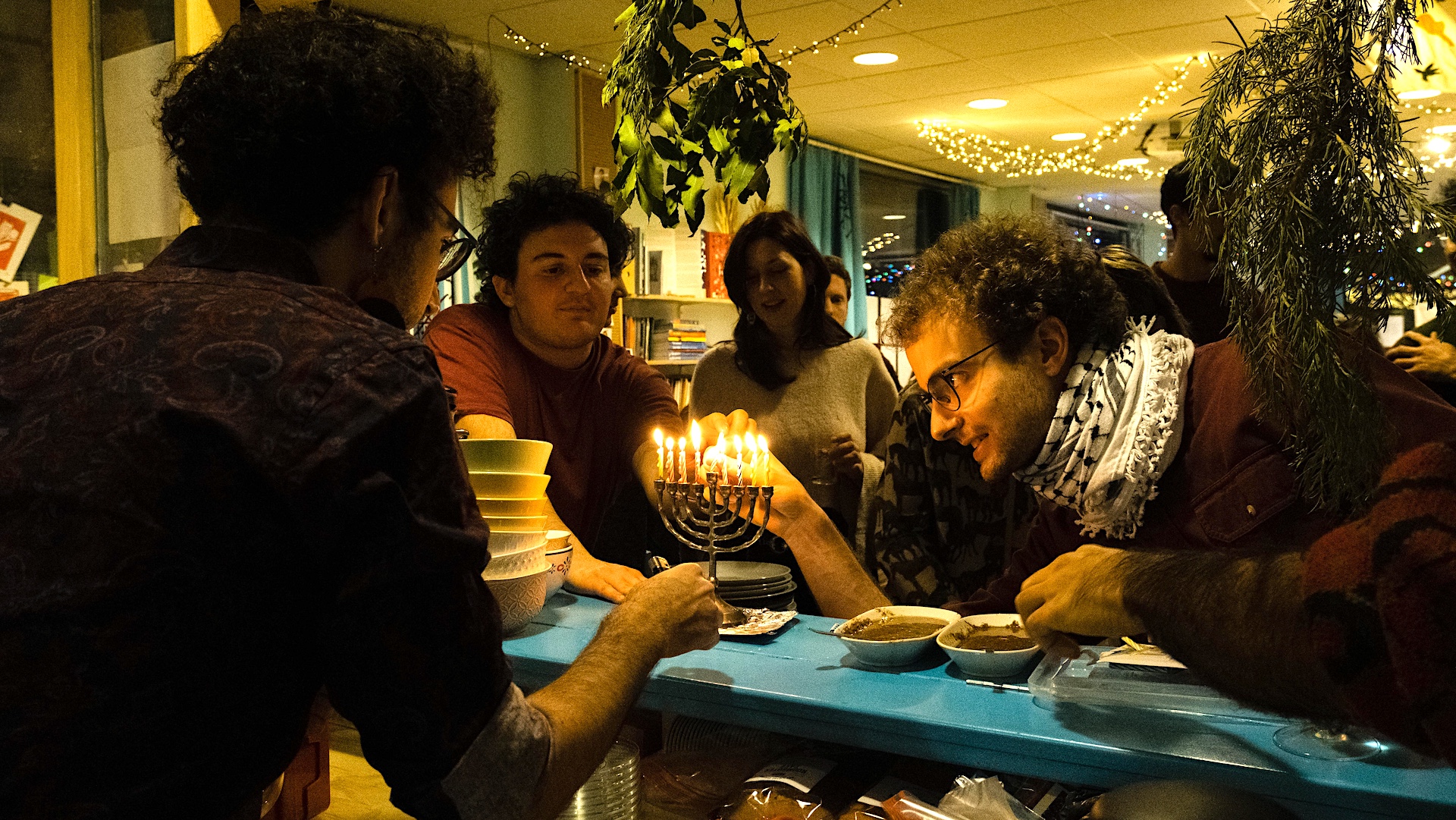
Members of Erev Rav, an anti-Zionist Jewish collective, organised a Hanukkah celebration to reflect on Judaism, Zionism and to commemorate Gaza.
It is six in the evening. The aroma of fried potato cakes, or Latkes, made on Hanukkah makes your mouth water. ’Today we are celebrating the miracle of oil, so we are going to deep-fry a lot!‘ says American Sophia Pekowsky (27). She flips the browned Latkes into the pan with a wooden spoon, ’It's a tradition that belongs to Ashkenazi cuisine.‘
Three young people are busy in the kitchen of meeting place De Voorkamer in Utrecht's Lombok district, where this party is taking place. Upon entering, a poster hangs on the wall with a QR code to raise money for humanitarian aid to Gaza. On a shelf separating the kitchen from the seating area is a plate of matzeballen. These traditional Jewish dumplings are normally eaten on Passover, but now they go into the soup
Sophia's curly brown hair is put up in a bun. She secures a lock of hair with a hairpin in the shape of a piece of watermelon. The symbol was created in response to the Israeli ban on Palestinian symbols and expressions of identity, such as the Palestinian flag. On her purple shirt is a printed remake of René Magritte's famous painting The Lovers; two kissing heads veiled with keffiyehs.
Maccabees
Members of Erev Rav, the anti-Zionist Jewish collective that organises this evening, gather to take a critical look at the symbolism of this festival. Hanukkah commemorates the triumph of the Maccabees on the Greco-Syrian army in 164 BCE. The reason for the Maccabean revolt was that King Antiochus IV Epiphanes of the Greco-Syrian empire, forbade the Jews in Jerusalem to practise their religion and ordered them to worship Greek gods. When the Maccabees regained the Second Temple after a three-year war, they found an oil jar large enough to keep the menorah, a seven-armed candelabrum, burning for one day. To their surprise, however, the menorah burned for eight days; a miracle that Jews celebrate for eight days every year, starting on 25 kislev according to the Hebrew calendar.
The chefs wave to the arriving guests. Almost everyone comments on the lights on the ceiling; ‘It's really nice here! The dishes are placed on the table by newcomers who have offered their help. Conversations in Dutch, English and Arabic fill the room and mingle with the background music. Sophia puts a small menorah on the table and, with the help of a young man with a keffiyeh, she provides it with small birthday candles. With a lighter, they melt the bottom of the candles so that they stick to the stand.
‘Some see the Maccabees as nationalists who fought for a Jewish land, which is a more Zionist interpretation of the story,’ Sophia tells listeners who have now all taken their seats. ‘Others see the Maccabees as fanatics who took on the more secular Jews as a rejection of Jewish assimilation.’ Here she refers to the Hellenistic Jews. ‘In that sense, Hanukkah is a symbol of rejection of Jewish assimilation in other communities.’

Hope in the darkness
Yet the festival has actually become a symbol of Jewish assimilation. This is especially true in the US, where it is sometimes even called ‘The Jewish Christmas’. There are Hanukkah trees and some wear ‘ugly Hanukkah jumpers’, Sophia says. The celebration has also become a symbol of America-Israel relations. Every year there is a Hanukkah celebration at the White House, a tradition started by former President George W. Bush. When Sophia recounts that in 2014, the US ambassador to Israel erected a menorah in the shape of a Iron Dome gift received from The White House, her listeners let out disapproving noises.
A number of participants share childhood memories - many stories about food -, and express gratitude that they can celebrate this festival today, without associating Judaism with Israel. Erev Rav member Itaï van der Wal shares his thoughts from the past few weeks: ‘I don't think I have ever celebrated Hanukkah so sad and heavy. Since the early days of the genocide campaign in Gaza, the strip has been cut off from food, water and oil.’ The mood turns. As soon as Gaza is mentioned, there is silence. People listen intently and look emotional. ‘I see a heartbreaking analogy between the story of the miracle of the menorah burning for eight days and the great scarcity there today at all levels. A miracle seems impossible now, but people in Palestine and around the world are rebelling. As terribly cliché as this sounds, there is some hope in the darkness. That is what this celebration stands for.’
BDS movement
Food is ready, including a Palestinian fennel salad with apples. Hossam Al-Farra (27) from Gaza recognises this dish, but remembers that the salad was prepared with pomegranate instead of dried cranberries. He too finds it special that he can celebrate Hanukkah today with a Jewish community. ‘One of the biggest problems with this issue is that it divides people, making it seem like it is a religious war and that Palestinians and Jews can never live together in peace. This is completely false. We have a lot in common in terms of religion, culture and language. It is not an ultimatum. It is not a choice between these people or those. The liberation of the Palestinians does not have to come at the expense of the Jewish community.’
At the table where he sits, German support for Israel is criticised. The international BDS [Boycott, Divestment, Sanctions] movement, which calls for increasing economic pressure on Israel to end the occupation, has been labelled anti-Semitic by the German parliament in 2019. Last year was the second year in which all Nakba protests and memorial activities were banned in May. Recently, in the state of Saxony-Anhalt, it has become a condition for getting a residence permit that you support Israel.
After these examples, the Netherlands suddenly comes across as very progressive. A change in Dutch attitudes towards Israel seems possible. ‘You already notice the difference in the police presence at pro-Palestinian protests,’ German Zolwei told the group. ‘Here the amount of police at demonstrations is standard, but in Germany the amount of riot police deployed during these demonstrations is insane. The cops surround the protest and then you are not allowed to leave it. Very strange.’

Antiboycott laws
Yuval Gal, co-founder of Erev Rav, talks about the birthday candles on the menorah, which soon burned out. ‘I wanted to buy special menorah candles, but found out that they are imported from Israel.’ His interlocutor recently joined BDS Netherlands. The 23-year-old Mayim shares a story about his recent job interview at a company that makes toys. ‘When they found out that I am Jewish, they enthusiastically told me that they would soon start selling their products to Israel as well. I was really offended, because they assumed that as a Jewish person I would be happy about this. While I did not support it at all. Why make this choice now as a company?’
In the US, the BDS movement has been labelled anti-Semitic by the US State Department. In addition, anti-boycott laws are in force in many states; companies calling for a boycott are punished. Recently, the US House of Representatives passed a law classifying anti-Zionism as anti-Semitism. ‘The fact that a law is passed so quickly in the US, when things like a ceasefire or protection for minorities cannot, is disgusting,’ says Mayim.
Confusion between anti-Zionism and anti-Semitism
On the eighth day of Hanukkah this year, activists from the US organisation organised Jewish Voices for Peace an action in which they closed eight different bridges and highways. They called attention to Gaza and demanded a ceasefire. Sophia thinks the action is a good example of the reinvention of the festival. ‘An important aspect of Jewish tradition is studying the Torah and reinterpreting its values,’ she says. ‘It is essential to reflect on this feast, discuss it and find new ways to celebrate it, outside of Zionism. As non-Zionist Jews, we can question the religious fundamentalism of the Maccabees and criticise the state of Israel, while celebrating the strength of the Jewish people.’
Sophia is concerned about the confusion that exists between anti-Zionism and anti-Semitism in the US and the rest of the world. ‘Anti-Semitism is a real problem that can take different forms. One is the assumption that all Jews are the same, or support one point of view. There is nothing as anti-Semitic as linking Judaism to a state that commits genocide. It is anti-Semitic to assume that all Jews support Israel.’
Photos: Chanukah celebration of Erev Rav at the Voorkamer in Utrecht (Judy Karajoli)
Rate this article
You read this article for free. Do you think the article and our efforts are worthwhile? Then you can show your appreciation by making a contribution. This way, you help our journalists and RFG Media.
About the author

About the author
Judy Karajoli
Judy Karajoli (born 1998, Damascus) lives in Utrecht and studies Journalism at the Hogeschool Utrecht. She worked as an editor/producer for the talk-show Hello Leiden. Hobbies and interests: photography, playing the piano, podcasts, yoga, storytelling, documentaries.
Read more
 From Amsterdam to Macondo. On the true magic of Colombia
 Bab el-Mandeb between Tehran and the Houthis: the power to disrupt rather than control
 Between two homes